
EEOC Drops Disparate Impact Probes: What It Means for Disabled Workers
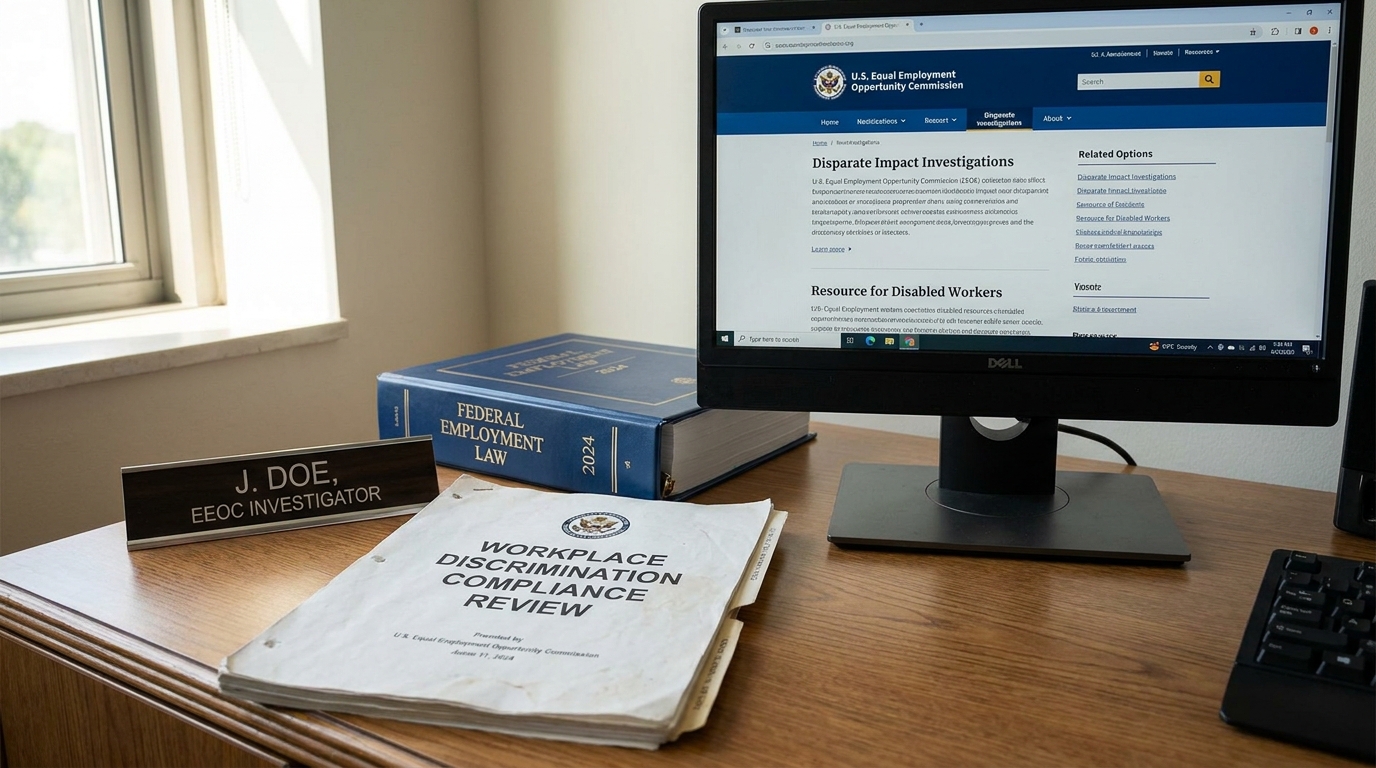
The federal agency responsible for investigating workplace discrimination has stopped pursuing an entire category of claims, but if you live and work in Redondo Beach, California, your rights may be stronger than you think. In late 2025, the Equal Employment Opportunity Commission (EEOC) directed its field offices to close pending charges that rely solely on disparate-impact theory by September 30, 2025, following President Trump’s April 2025 executive order directing federal agencies to abandon that legal framework. The agency also instructed that ‘Right to Sue’ letters be issued to affected charging parties by October 31, 2025. For workers with disabilities in California, this federal retreat raises an urgent question: does this rollback weaken your ability to hold an employer accountable? The short answer is no, and understanding why requires a closer look at how California’s independent legal protections work.
What the EEOC’s Enforcement Shift Means for Disability Claims
The scale of this change cannot be overstated. The EEOC made a major shift in its enforcement priorities heading into 2026, instructing all field offices to close pending charges that rely solely on disparate-impact theory by September 30, 2025, and to issue ‘Right to Sue’ letters to affected charging parties by October 31, 2025, a historic departure from a core enforcement approach the agency has relied on for decades. Disparate impact claims allowed workers to challenge neutral-sounding policies that disproportionately harmed people in protected classes, including those with disabilities.
However, the underlying federal law has not changed. While this executive order represents the present administration’s enforcement priorities, it does not change the law for most employers. Title I of the ADA still requires employers to provide reasonable accommodation to qualified individuals with disabilities, except when it would cause undue hardship. And critically, state and local agencies may still pursue disparate-impact investigations, which is where California’s robust legal framework enters the picture.
For California residents, the more relevant question is how state law operates independently. The California Fair Employment and Housing Act (FEHA), the Unruh Civil Rights Act, and the Disabled Persons Act are state laws that protect people from disability discrimination. These protections are grounded in Government Code sections 12926, 12926.1, and 12940, a separate statutory framework that does not depend on federal EEOC action.
When Your Employer Ignores a Disability: A Redondo Beach Scenario
How a Routine Accommodation Request Can Become a Legal Case
Consider a Redondo Beach office worker, call her Maria, who develops chronic migraines that her neurologist classifies as a disability. Maria submits a written request for a modified schedule: she asks to start one hour later on days following severe episodes. Her supervisor verbally agrees, but HR never responds. Weeks pass. Maria misses two mornings during a flare-up, and her employer issues a written warning citing attendance violations. A month later, she is terminated.
Maria’s situation is far more common than many people realize. Her employer received notice of a qualifying disability, failed to engage in a good-faith interactive process, and then took an adverse employment action, termination, that appears causally linked to her disability and accommodation request. Under both the ADA and FEHA, that sequence of events can form the basis of a viable claim. The fact that the EEOC may no longer investigate certain types of disparate impact claims does not diminish Maria’s right to pursue a disparate treatment or failure-to-accommodate case.
How to Prove Disability Discrimination Under California’s FEHA
California’s FEHA regulations explicitly require that disability discrimination law be construed broadly in favor of expansive coverage. Under FEHA regulations at 2 CCR § 11064, the primary focus in disability cases should be whether employers provided reasonable accommodation and engaged in the interactive process, not whether the individual narrowly meets the definition of disability. This plaintiff-friendly standard persists regardless of what happens at the federal level.
To prove a disability discrimination claim in California courts, a plaintiff generally must establish the following elements, as outlined in CACI jury instruction No. 2540:
- The employee had a physical or mental disability, or the employer perceived the employee as having one
- The employee was able to perform the essential duties of the job, with or without reasonable accommodation
- The employer took an adverse employment action (termination, demotion, denial of hire, etc.)
- The disability was a substantial motivating reason for the adverse action
- The employee suffered harm as a result
Each of these elements requires documentation, and the burden of gathering that evidence falls on the employee. Medical records, written accommodation requests, emails from supervisors, performance evaluations, and witness statements all play critical roles. California broadly defines disabilities as conditions that limit a major life activity, including both physical and mental disabilities, a definition that may offer wider protection than the federal standard.
The Interactive Process: Where Many Employers Fail
One of the strongest tools available to California employees is the interactive process requirement. Under FEHA, employers must engage in a timely, good-faith dialogue with an employee who requests accommodation. This is not optional. When an employer refuses to participate or simply ignores the request, as in Maria’s scenario, that failure itself can constitute a separate violation under CACI No. 2546 (Disability Discrimination – Reasonable Accommodation – Failure to Engage in Interactive Process, Gov. Code Section 12940(n)).
The law also requires an employer to provide reasonable accommodation unless doing so would cause significant difficulty or expense. Employers in California are additionally prohibited from inquiring about the nature or severity of a disability during the hiring process. These protections create multiple potential claims for an employee who has been mistreated, even in a single incident.
Filing Deadlines and Administrative Requirements
Time limits matter, and they are enforced strictly. In California, employees generally must file a complaint with the Civil Rights Department (formerly DFEH) before filing a lawsuit under FEHA. Courts interpret deadline extensions narrowly, and missing an administrative filing window may bar a claim entirely. While some tolling or discovery-rule exceptions may apply in limited circumstances, no deadline extension is guaranteed or automatic.
At the federal level, employees typically have 300 days to file an EEOC charge in states with a local fair employment agency, which includes California. ADA cases made up approximately 31.5% of the EEOC’s FY 2025 filings, down from approximately 43% in FY 2024. Final FY 2026 filing statistics are not yet available as the fiscal year does not end until September 30, 2026. Federal disability enforcement through EEOC accommodation guidance remains active for intentional discrimination and failure-to-accommodate claims. Workers should not assume federal avenues are closed.
Protecting Your Claim: Evidence That Matters
The strongest disability discrimination cases are built on contemporaneous documentation. If you believe your employer is discriminating against you because of a disability, consider preserving the following:
- Written accommodation requests, email is preferable to verbal requests
- Medical documentation linking your condition to a major life activity limitation
- Employer communications, any emails, texts, or memos referencing your disability, attendance, or performance
- Timeline of events, when you disclosed your condition, when you requested accommodation, and when the adverse action occurred
- Witness information, coworkers who observed discriminatory treatment or overheard relevant statements
Do not wait to begin gathering this evidence. Employers routinely purge records, and memories fade. Early documentation can be the difference between a case that succeeds and one that stalls. Keep copies of everything in a location your employer cannot access.
How Does This Impact Me?
Does the EEOC’s pullback on disparate impact mean I can no longer file a disability discrimination claim?
No. The EEOC stopped investigating claims based solely on disparate impact theory. Intentional discrimination (disparate treatment), failure to accommodate, and retaliation claims remain fully enforceable at both the federal and state level. California’s disability rights protections under FEHA operate independently of federal enforcement priorities.
What should I do if my employer refused my accommodation request?
Document the refusal immediately. Send a follow-up email summarizing the conversation and your original request. Under California law, your employer’s failure to engage in the interactive process may itself constitute a violation, separate from any adverse employment action that follows. Consult an attorney to evaluate your specific situation.
How do I know if my condition qualifies as a disability under California law?
California defines disability more broadly than federal law in many cases. A condition that limits a major life activity, including working, concentrating, sleeping, or interacting with others, may qualify. FEHA regulations instruct that the definition be construed broadly in favor of expansive coverage. However, whether your specific condition qualifies depends on the facts of your case.
Does this affect my deadline to file a complaint?
Filing deadlines have not changed as a result of the EEOC’s enforcement shift. You must still comply with applicable state and federal timelines. In California, the administrative filing deadline under FEHA is generally three years from the date of the discriminatory act, but you should not delay, evidence deteriorates and procedural requirements can be complex.
Can my employer retaliate against me for filing a disability discrimination complaint?
Retaliation is illegal under both the ADA and FEHA. Job applicants and current and former employees are protected from retaliation for asserting their rights under the ADA, and speaking out about or exercising rights related to workplace discrimination is called "protected activity." If your employer takes adverse action against you for requesting accommodation or filing a complaint, that may give rise to an additional claim.
Your Rights Have Not Disappeared, But Acting Quickly Matters
The EEOC’s retreat from disparate impact enforcement is a significant policy shift, but it does not erase the legal protections available to California workers with disabilities. FEHA’s broad definitions, the interactive process mandate, and state-level jury instructions all remain fully in effect. For Redondo Beach residents and workers across California, the question of how to prove disability discrimination still has clear, actionable answers rooted in decades of state law. What has changed is the enforcement landscape, and that makes informed, proactive legal action more important than ever.
Every disability discrimination case depends on its specific facts. This article provides general legal information and is not a substitute for individualized legal advice. No outcome is guaranteed.
If the recent shift in federal enforcement has left you uncertain about your rights, the team at Kent | Pincin can help you understand where you stand. To discuss your situation with an experienced disability discrimination attorney serving Redondo Beach and throughout California, call (310) 424-4991 or reach out online to schedule a consultation.