
How Long Does an Insurer Have to Investigate a Claim in Nebraska?
Understanding Insurer Deadlines After a Nebraska Car Crash
Key Takeaways: In Nebraska, an insurer must begin investigating a car accident claim within 15 days of receipt of proof of loss from a claimant under 210 Neb. Admin. Code, ch. 61, § 007.01; however, that provision governs life, sickness, and accident claims rather than property and casualty claims. Property and casualty claims in Nebraska, including auto losses, are governed by 210 Neb. Admin. Code, ch. 60 (the Unfair Property and Casualty Settlement Practices Rule), which sets settlement standards under § 008 (applicable to all insurers) and § 009 (applicable to automobile losses). While no single statute caps the total investigation length, Nebraska law sets enforceable expectations of promptness and fairness that protect injured people from unreasonable stalling. Understanding the auto accident claim timeline in Nebraska helps you recognize when an adjuster is moving too slowly.
If you were recently injured in a collision, you deserve to know exactly when an insurance company must act on your claim. In Nebraska, certain insurance regulations require an insurer to begin investigating a claim within 15 days of receipt of proof of loss from a claimant (see 210 Neb. Admin. Code, ch. 61, § 007.01 for life, sickness, and accident claims); property and casualty claims, including auto losses, are governed by 210 Neb. Admin. Code, ch. 60, which sets settlement standards under § 008 and § 009. While no single statute caps the total investigation days, Nebraska law sets enforceable expectations of promptness and fairness that protect injured people from unreasonable stalling. Understanding the auto accident claim timeline in Nebraska helps you recognize when an adjuster is moving too slowly.
At Kent | Pincin, we help injured Nebraskans hold insurers accountable when they drag their feet. Contact the team at Kent | Pincin, call us at (402) 243-5535, or use our online case review form to discuss your next steps. The sooner you understand the applicable deadlines, the better positioned you are to protect your recovery.
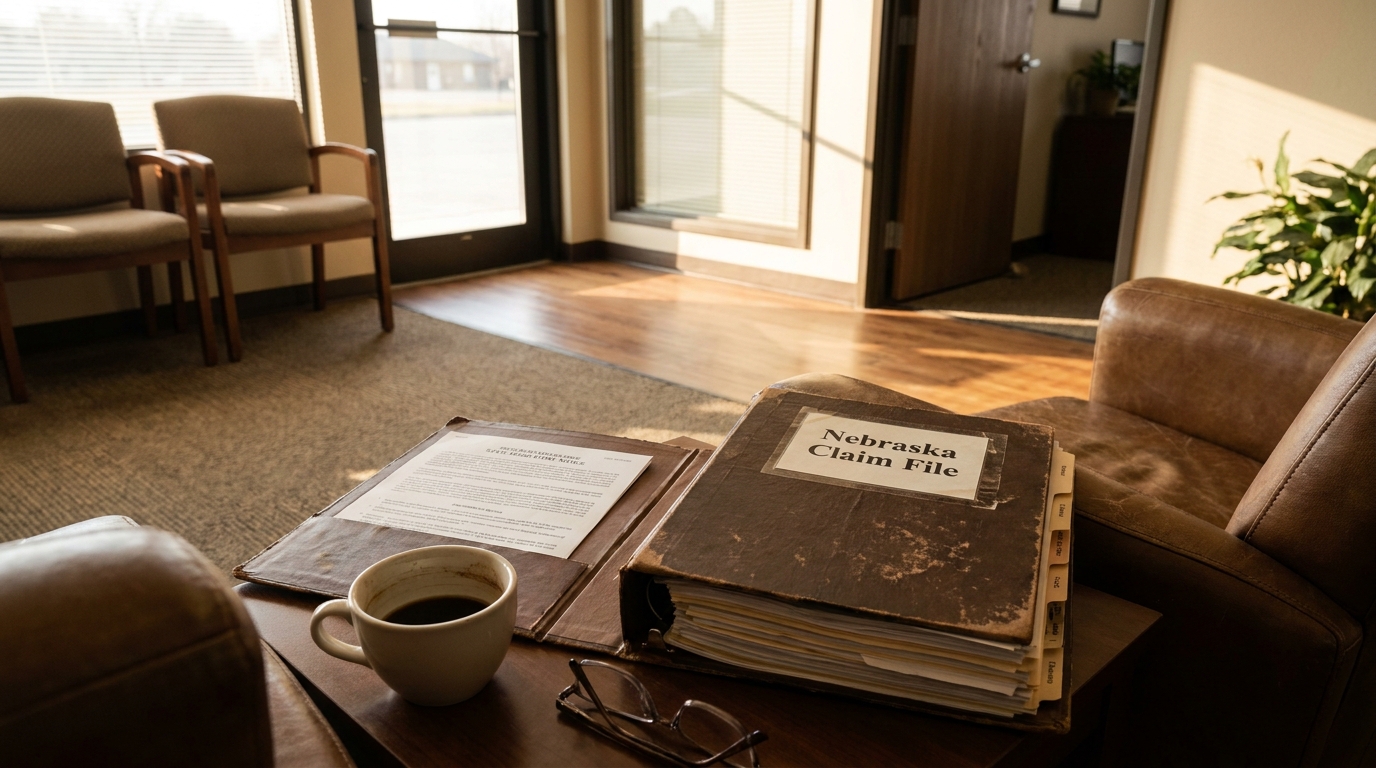
How Long Does an Insurance Company Have to Investigate a Claim in Nebraska?
A Nebraska insurer must start its investigation quickly, though the law does not fix one universal end date. Under 210 Neb. Admin. Code, ch. 61, § 007.01, every insurer shall, within fifteen (15) days of receipt of proof of loss from a claimant, initiate investigation of any claim presented by a claimant; however, that provision applies to life, sickness, and accident claims. Property and casualty claims in Nebraska, including auto losses, are governed by 210 Neb. Admin. Code, ch. 60 (the Unfair Property and Casualty Settlement Practices Rule), which sets settlement standards under § 008 (applicable to all insurers) and § 009 (applicable to automobile losses). This administrative framework provides the clearest starting benchmark for when an insurer must take meaningful action on a claim.
After the investigation begins, Nebraska law shifts focus from strict countdown to a reasonableness standard. The Unfair Claims Settlement Practices Act requires that an insurer affirm or deny coverage within a reasonable time once its investigation is complete. Section 44-1540(8) prohibits failing to affirm or deny coverage of a claim within a reasonable time after having completed its investigation related to such claim. What counts as reasonable depends on crash complexity, the parties involved, and required records.
💡 Pro Tip: Document the exact date you submitted proof of loss in writing, so you have clear record of when the 15-day investigation clock started.
The 15-Day Investigation Trigger and What Follows
The 15-day rule does not mean your entire claim must be resolved in two weeks. It means the insurer must take meaningful action to begin reviewing your claim within that window. From there, Nebraska insurance law expects continued diligence. For a focused breakdown of this deadline, our article on how Nebraska insurers must investigate your auto claim walks through the practical timeline.
Several related duties reinforce that the investigation cannot stall without consequence. These overlapping obligations keep your claim moving forward.
-
Insurers must provide forms necessary to present claims, with reasonable explanations regarding their use, within fifteen working days of a request under Section 44-1540(14).
-
Insurers must acknowledge with reasonable promptness pertinent communications with respect to claims under Section 44-1540(2).
-
Insurers must adopt and implement reasonable standards for the prompt investigation and settlement of claims under Section 44-1540(3).
What Nebraska’s Unfair Claims Settlement Practices Act Requires
Nebraska’s core protections against insurer delay live in Chapter 44 of the Revised Statutes. The Unfair Claims Settlement Practices Act is codified at sections 44-1536 through 44-1544, with central prohibitions appearing in two companion statutes. Statutes 44-1539, titled unfair claims settlement practice; conduct prohibited, and 44-1540, titled unfair claims settlement practice; acts and practices prohibited, are listed in the Chapter 44 index. This Act is enforced primarily by the Director of the Nebraska Department of Insurance and does not by itself create a private right to sue, although a separate common-law bad faith claim may be available to a first-party insured in some circumstances.
Section 44-1539 explains when prohibited conduct rises to the level of an unfair practice. It is an unfair claims settlement practice for any domestic, foreign, or alien insurer transacting business in this state to commit an act or practice defined in section 44-1540 if the act or practice is committed flagrantly and in conscious disregard of the Act, or has been committed with such frequency as to indicate a general business practice. You can review the full statutory text through the Nebraska Legislature’s record of section 44-1539.
Specific Delay Tactics the Law Prohibits
Section 44-1540 lists concrete behaviors that injured claimants frequently encounter. These provisions target the most common forms of insurance company delay in Nebraska. Knowing them helps you spot when an adjuster crosses the line.
| Statutory Provision | Prohibited Conduct |
|---|---|
| § 44-1540(3) | Failing to adopt reasonable standards for prompt investigation and settlement |
| § 44-1540(7) | Refusing to pay claims without a reasonable investigation |
| § 44-1540(8) | Failing to affirm or deny coverage within a reasonable time |
| § 44-1540(12) | Delaying by requiring duplicative proof-of-loss documentation |
| § 44-1540(14) | Failing to provide claim forms within fifteen working days |
Two provisions deserve special attention because they directly attack delay. First, Section 44-1540(7) prohibits refusing to pay claims without conducting a reasonable investigation. Second, Section 44-1540(12) prohibits unreasonably delaying the investigation or payment of claims by requiring both a formal proof-of-loss form and subsequent verification that would result in duplication of information.
💡 Pro Tip: If an adjuster repeatedly asks for documents you already submitted, keep copies of each request, as duplicative demands may signal a prohibited delay tactic.
The Regulation Behind the Statute: Title 210, Chapter 60
The statutory duties are reinforced by a detailed administrative rule. Chapter 60 is titled Unfair Property and Casualty Settlement Practices Rule and is issued by the Nebraska Department of Insurance under Title 210. This rule has been effective since September 1, 1992. You can read the regulation through the Nebraska property and casualty settlement rule.
The regulation also sets settlement standards tailored to different loss types. It establishes standards for prompt, fair and equitable settlements, including § 008 applicable to all insurers, § 009 applicable to losses involving automobiles, and § 010 applicable to fire and extended coverage type policies. Section 009 speaks directly to automobile losses and is particularly relevant to anyone navigating the auto accident claim process in Nebraska.
When Delay May Become an Unfair Practice
A slow response alone does not automatically prove a violation. The law generally looks at whether conduct was flagrant or part of a repeated pattern. This distinction matters because the Department of Insurance and courts interpret these standards in light of specific facts, and a reasonable investigation of a complicated crash may legitimately take longer.
💡 Pro Tip: Send important claim communications in writing and request written responses to build a timeline demonstrating whether delays were reasonable or excessive.
Practical Steps If Your Claim Stalls
When an insurer goes quiet, you still have options to keep your claim moving. Staying organized and assertive often makes the difference in how quickly an adjuster responds. A trusted Nebraska accident attorney can also intervene to apply pressure grounded in the statutory deadlines.
Building a strong record early protects your ability to challenge delay later. Preserve medical records, repair estimates, photographs, and witness contact information. These materials help establish negligence, causation, and damages.
💡 Pro Tip: Note every adjuster’s name and call date, as a clear contact log can later support a complaint or claim of unreasonable delay.
Frequently Asked Questions
1. How quickly must a Nebraska insurer start investigating my auto claim?
Generally within 15 days of receipt of proof of loss. Under 210 Neb. Admin. Code, ch. 61, § 007.01, every insurer shall, within fifteen days of receipt of proof of loss from a claimant, initiate investigation of any claim presented by a claimant; however, that provision applies to life, sickness, and accident claims. Property and casualty claims, including auto losses, are governed by 210 Neb. Admin. Code, ch. 60, which sets settlement standards under § 008 and § 009.
2. Is there a hard deadline for the insurer to pay or deny?
Not a fixed number of days, but a reasonableness standard applies. Section 44-1540(8) prohibits failing to affirm or deny coverage within a reasonable time after completing its investigation. What is reasonable varies with claim complexity.
3. Can an insurer keep asking for the same paperwork?
Repeated, duplicative demands may be prohibited. Section 44-1540(12) bars unreasonably delaying investigation or payment by requiring both a formal proof-of-loss form and subsequent verification that would duplicate information. Keep copies of everything you submit.
4. What makes delay an unfair claims settlement practice?
The conduct generally must be flagrant or part of a pattern. Under section 44-1539, the act must be committed flagrantly and in conscious disregard of the Act, or with such frequency as to indicate a general business practice. A single delay may not meet that threshold.
5. Where can I read the statutes myself?
Nebraska publishes them online. The Legislature maintains the official text of the prohibited acts statute, and you can review the listed conduct directly through section 44-1540. Because the Act is enforced mainly by the Department of Insurance and outcomes depend on your specific facts, reviewing the law is a starting point rather than legal advice.
Protecting Your Recovery After a Nebraska Collision
Nebraska law gives injured people meaningful tools to combat insurer delay. The 15-day investigation trigger, the reasonable-time standard for coverage decisions, and the detailed prohibitions in section 44-1540 all work together to keep your claim moving. Because these standards turn on whether conduct was reasonable, flagrant, or part of a pattern, and because enforcement runs through the Department of Insurance, the strength of your position depends on careful documentation and your crash circumstances.
You do not have to face an unresponsive insurer on your own. If your auto accident claim has stalled, the team at Kent | Pincin is ready to help you understand your options, reach us by phone at (402) 243-5535, or request a review through our confidential contact page. Acting promptly helps protect both your claim and your peace of mind.