
Driver Charged in Fatal Madison Hit-and-Run: Work Zone Crash Claims
A recent Wisconsin DMV reminder about minimum auto insurance requirements is more than a licensing story, it’s a practical warning for Madison residents who may be injured by an uninsured driver. As of May 5, 2026, Wisconsin requires liability insurance for drivers, with violations resulting in fines up to $500. For injured people, the critical issue isn’t the ticket, it’s facing medical bills, missed work, and an at-fault driver with no coverage.
Why This Matters in Madison After a Crash
Wisconsin law requires drivers to carry minimum liability insurance, but minimum compliance and real-world recovery aren’t the same thing. The Wisconsin DMV states minimum required liability coverage is $25,000 for injury or death of one person, $50,000 for injury or death of more than one person, and $10,000 for property damage, while the Wisconsin Office of the Commissioner of Insurance explains policies must also include uninsured motorist bodily injury coverage with minimum limits of $25,000 per person and $50,000 per accident. When driving without insurance Wisconsin becomes part of a crash case, injured people often must look beyond the at-fault driver’s ability to pay toward all available insurance sources, including uninsured motorist benefits.
That legal context shapes how injury claims are investigated and valued. Even when the other driver lacks insurance, the injured person must prove negligence, causation, and damages. In Wisconsin, comparative negligence can reduce recovery if the injured person is assigned fault, and recovery may be barred if the plaintiff’s negligence exceeds the other party’s negligence under comparative negligence.
The insurance problem is often discovered late
Many people don’t learn the other driver is uninsured until after the initial collision shock has passed. A driver may provide incomplete information at the scene, a claims adjuster may deny coverage, or a hit-and-run investigation may reveal no liability carrier exists. By then, the injured person may be dealing with emergency treatment, vehicle loss, and pressure from multiple insurers.
That’s why documentation matters from day one. Police reports, scene photos, witness names, medical records, wage-loss proof, and electronic communications about the crash can affect available compensation. When driving without insurance Wisconsin is involved, careful documentation becomes even more critical because liability coverage may not streamline payment.
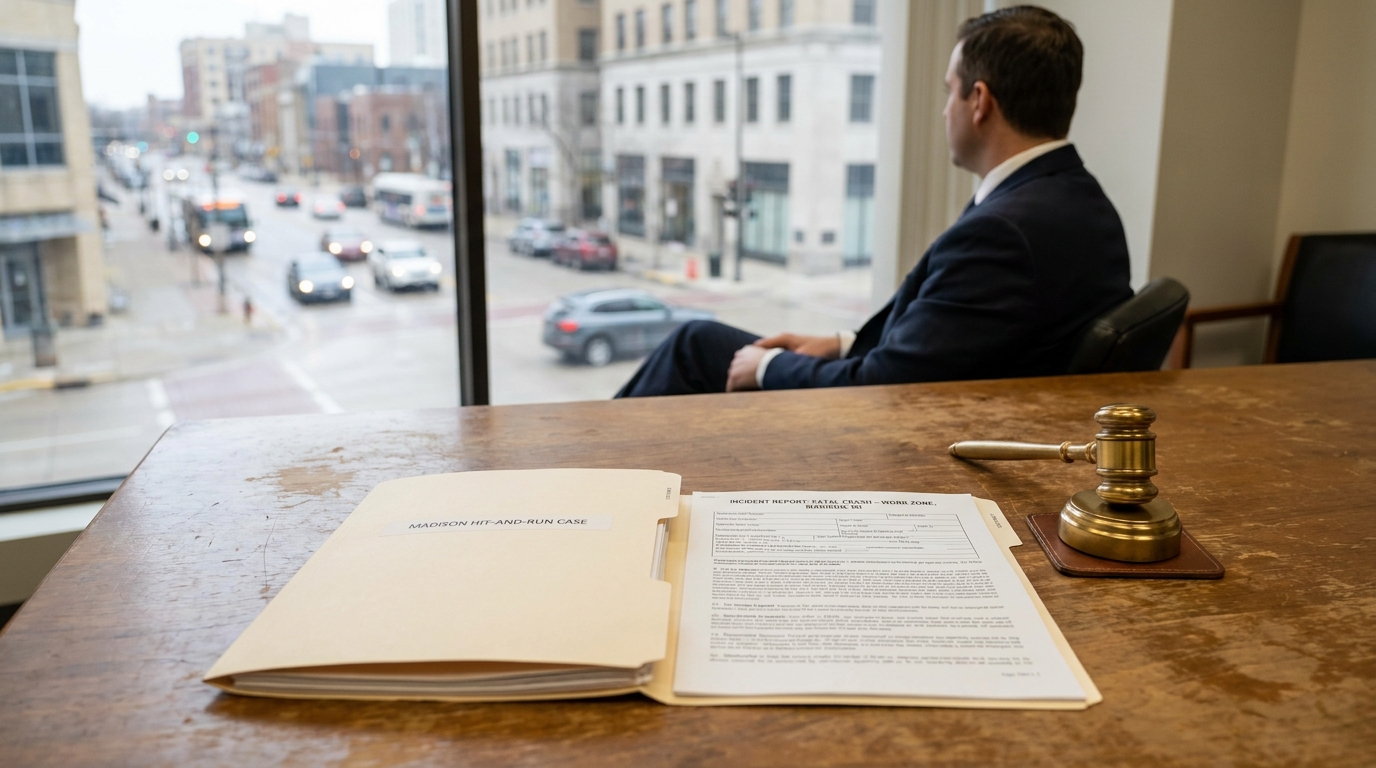
A Madison Scenario That Shows the Real Risk
Imagine a Madison commuter struck near a construction corridor by a driver with no valid liability insurance. The injured person suffers a fractured wrist, concussion, and several weeks of lost income. Initially, the case seems straightforward because the other driver ran a light. Then the problem appears: no liability policy exists to cover hospital bills, wage loss, or pain-related damages.
In that situation, the injured person’s own policy becomes central. Wisconsin’s insurance framework requires uninsured motorist bodily injury coverage in auto policies, and OCI explains this coverage can apply when injured by an uninsured driver or hit-and-run driver, including as a pedestrian in some circumstances. That doesn’t make recovery automatic, it means another path may exist while still proving fault, injuries, and damages.
Why injured victims should not assume "no insurance" means "no case"
A driver’s lack of insurance doesn’t necessarily end the civil injury claim. Depending on facts, an injured person may access uninsured motorist coverage, medical payments coverage, claims involving additional liable parties, or evidence supporting broader negligence theories. In some cases, vehicle ownership, employment-related use, or other policy issues can materially change the analysis.
This is where prompt legal review matters. Uninsured-driver cases can involve policy interpretation, notice requirements, proof disputes, and negotiations with the injured person’s own carrier, different from simple two-car crashes with clear third-party liability insurance.
What Driving Without Insurance Wisconsin Means for an Injury Claim
From the victim’s perspective, driving without insurance Wisconsin is a claim-value issue, an evidence issue, and often a timing issue. Wisconsin DMV guidance states operating a vehicle without insurance may result in fines up to $500, but that penalty doesn’t compensate for surgery, rehabilitation, or reduced earnings. Civil recovery depends on proving fault and identifying every available compensation source.
Practical consequences include delays and insurer scrutiny. When the at-fault driver lacks coverage, the injured person may claim under their own uninsured motorist coverage, creating a different adversarial process. The insurer may examine medical causation, prior injuries, treatment nature, and whether evidence supports the amount demanded.
That makes early case-building especially important. Useful evidence includes:
- Crash report and citations issued
- Photos of vehicle damage, road conditions, and injuries
- Witness statements gathered promptly
- Medical records tying symptoms to collision
- Employer records showing missed time and lost pay
- Policy documents for all potentially applicable coverage
Work-zone and distraction facts still matter
Wisconsin safety materials emphasize risks associated with work zones and distracted driving. WisDOT states it’s illegal to use a handheld mobile device while driving in a Wisconsin work zone, and the agency reports Wisconsin sees more than 2,100 work zone crashes annually. These facts matter if a Madison crash occurred near construction and distraction evidence explains the collision.
These surrounding facts can support the negligence narrative. If phone use, speeding, or poor attention contributed, that evidence may establish liability even when insurance issues complicate payment. Stronger liability cases often strengthen uninsured motorist claims.
Deadlines and Fault Rules Can Still Shape the Outcome
Lack of insurance doesn’t suspend civil deadlines. Wisconsin law generally provides a three-year limitations period for actions to recover damages for injury to the person or death caused by wrongful act, neglect, or default. Some injured people spend weeks determining whether the other driver had coverage, losing valuable claim-preservation time.
Deadline exceptions and tolling doctrines may exist in limited circumstances, but courts interpret exceptions narrowly. Whether exceptions apply depends on facts, claim type, and parties involved. Government-related claims can involve separate administrative notice rules and shorter deadlines.
Comparative negligence remains important
Even where the other driver was uninsured, Wisconsin’s fault-allocation rules matter. OCI’s consumer guidance explains Wisconsin follows a comparative negligence approach where an injured person may recover damages if their negligence doesn’t exceed the other party’s, but recovery can be reduced by their percentage of fault. Strong uninsured-driver cases require attention to speed, lookout, signaling, seat belt issues, and other facts insurers may use to shift blame.
That’s especially relevant in intersection crashes, lane-change collisions, and pedestrian cases. Insurers often seek partial-fault arguments when significant injury exposure exists. For Madison families dealing with fatal collisions, related civil issues can overlap with wrongful death rules on who may bring claims and available damages, discussed in this firm’s piece on Madison pedestrian wrongful death.
Practical Steps After a Suspected Uninsured-Driver Crash
The first priority after any serious collision is medical care and safety, but next steps can materially affect legal claims. If you suspect the other driver was uninsured or gave questionable insurance information, preserving evidence quickly may avoid later disputes.
What to do in the first days
Make the record as complete as possible. Obtain the crash report number, notify your insurer promptly, and keep every bill, prescription receipt, and work-loss document. Avoid assuming the other driver’s insurer will resolve everything.
If injuries are significant, organized documentation strengthens both liability and damages. Consider:
- Following treatment instructions consistently
- Keeping a pain and symptom journal
- Saving texts, emails, or voicemail related to the crash
- Identifying surveillance or dashcam sources quickly
Why legal evaluation can be different in uninsured-driver cases
These cases often involve multiple legal and insurance questions simultaneously. Issues may include uninsured motorist notice, settlement procedure, policy limits, exclusions, or whether another vehicle owner or employer shares responsibility. The analysis is rarely as simple as "no insurance means no recovery."
Some injured people in Madison seek case-specific guidance rather than generic insurance information. Readers wanting broader background on collision claims can review this firm’s page about working with a Madison auto accident lawyer, especially when medical bills and insurer pushback affect recovery.
How Does This Impact Me?
What does this mean if the driver who hit me had no insurance?
Your claim may shift toward uninsured motorist coverage and other available recovery sources. You generally need to prove fault, causation, and damages, and your own insurer may closely review the claim. The absence of liability insurance doesn’t automatically defeat a case, but it changes the path.
Does driving without insurance Wisconsin change my deadline to file?
Usually no, the other driver’s insurance status doesn’t extend the civil filing deadline. Wisconsin injury and wrongful death deadlines may still apply, and exceptions exist only in limited circumstances. Separate rules may apply if a government entity is involved.
What if I was a pedestrian, passenger, or cyclist?
Your status outside the driver’s seat doesn’t necessarily prevent recovery. Depending on facts and policy language, uninsured motorist coverage may apply to injuries involving pedestrians, passengers, or hit-and-run events. Specific policy wording, relationship to the insured vehicle, and crash facts all matter.
Can my own insurance company fight my claim?
Yes, even though the claim is under your own policy. The insurer may dispute fault, injury severity, treatment reasonableness, or pain and suffering value. That’s why detailed medical and crash documentation matters in uninsured-driver cases.
What should I do next if I think insurance information is missing or false?
Act promptly but carefully. Seek medical attention, report the crash, notify your insurer, preserve documents, and avoid guessing about coverage until information is verified. A case-specific review may clarify applicable coverage and deadlines.
What Madison Readers Should Take Away
Current Wisconsin insurance rules remind us legal minimums don’t always protect injured people from serious crash fallout. When driving without insurance Wisconsin is part of the facts, key questions become who was negligent, what evidence proves injuries, what insurance may respond, and how long the injured person has to act. For Madison victims, stakes are immediate: treatment, wage loss, transportation, and family stability.
No article can answer every case-specific question, and this is not individualized legal advice. Understanding the difference between a traffic violation and a compensable injury claim helps injured people make better early decisions. In uninsured-driver cases, early documentation, careful review of applicable policies, and realistic assessment of fault and damages are central to protecting claims.
If you have questions about how a Madison crash involving an uninsured driver may affect your options, Kent \| Pincin may be a useful resource. You can call 608.999.4954 or contact us today to request more information about your situation.