
How an Accident on Your Carfax Report Lowers Your Car’s Resale Value in Nebraska
Why a Carfax Accident Record Can Cost You Money After a Nebraska Crash
Key Takeaways: A Carfax accident record can lower your car’s resale value even after repairs are done, because buyers and dealers tend to offer less for vehicles with a reported collision. This loss is called "diminished value," or "stigma damages." Nebraska law may allow you to seek it from the at-fault driver. It is generally measured by the difference in your car’s market value right before and right after the crash. Insurers may use Carfax data or formulas to argue your loss is small, but an independent appraisal, written dealer offers, and good repair records can support a higher claim. Under Nebraska’s modified comparative negligence rule, your share of fault can reduce your recovery or bar it entirely. Property damage lawsuits generally must be filed within four years under Neb. Rev. Stat. § 25-207. Claims involving government vehicles have different requirements and deadlines.
A Carfax accident record can lower your car’s resale value even after the repairs are finished. Many used car buyers and dealers see a reported collision and offer less, even when the vehicle looks and drives like new. This drop in value, often called "diminished value," is a real financial loss on top of your repair bills. If someone else caused your Nebraska car accident, you may be able to pursue a diminished value claim to recover some or all of that loss.
If another driver’s negligence left you with a damaged car and a lower resale value, you may have options. The legal team at Kent | Pincin can review your situation and explain your next steps. Call (402) 243-5535 or contact us now to schedule a consultation.
How Accident History Affects Used Car Value
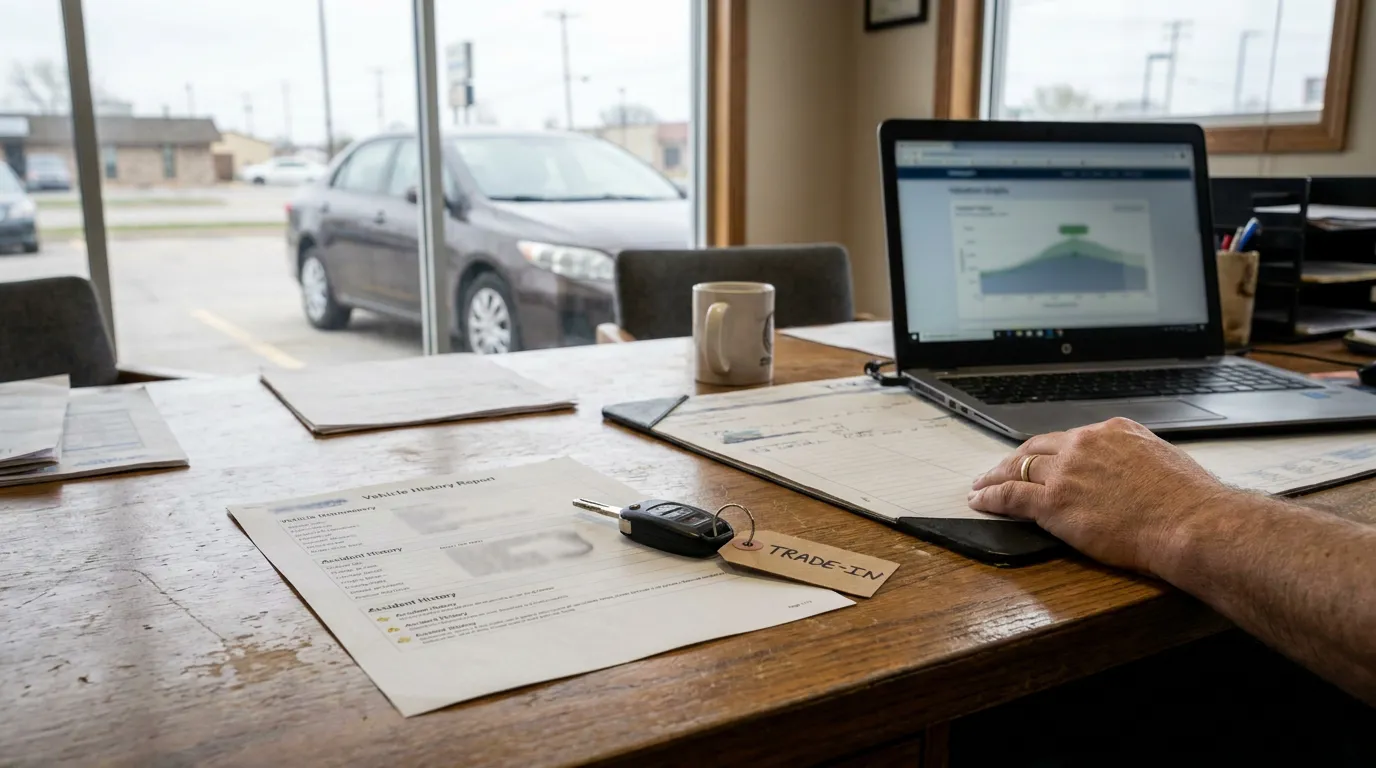
Buyers usually pay less for vehicles with a reported accident history. When a shopper sees an accident on a vehicle history report, they often worry about hidden frame damage, poor repairs, or future mechanical problems. Those worries tend to show up as lower offers, whether the car is sold privately or traded in.
The Stigma Behind a Vehicle History Report Accident
The loss in value often comes from how the market sees a damaged car, not from the car’s actual condition. This is why diminished value is sometimes described as "stigma damages." Two identical vehicles with the same mileage and features can sell for different prices simply because one has a Carfax entry showing a collision. Academic work, including a 1987 study on used car reliability and price published in the Journal of Consumer Affairs, has looked at how buyers respond to vehicle condition information, finding that price depreciation was largely independent of reliability performance. Research like this suggests that market perceptions of a vehicle, including a reported accident, can affect value in ways that don’t always track the car’s actual condition, not only in Nebraska.
Trade-In Value After an Accident
Dealers often cut trade-in offers sharply for cars with an accident on record. Dealers have to resell the car, and they know their customers may see the same report. The size of the drop usually depends on the vehicle’s age, its pre-accident value, the severity of the damage, and whether structural parts or airbags were involved.
Building a Diminished Value Claim in Nebraska
Nebraska law generally lets people whose property was damaged by someone else’s negligence seek compensation for that loss. Nebraska courts generally measure damage to personal property by the difference in the vehicle’s market value right before and right after the collision. Reasonable repair costs may also serve as evidence of that loss. Total recovery generally cannot exceed the vehicle’s pre-accident value. A diminished value claim is typically brought against the at-fault driver and negotiated with that driver’s liability insurer. You can also learn more about recoverable car accident damages such as medical bills, lost income, and pain and suffering.
Proving Fault and Causation
To recover diminished value, you generally have to show the other driver was negligent and that the crash caused your car’s loss in value. Police reports, photos, witness statements, and sometimes accident reconstruction can help establish negligence. Nebraska follows a modified comparative negligence rule under Neb. Rev. Stat. §§ 25-21,185.07 to 25-21,185.12. Under § 25-21,185.09, your recovery is reduced in proportion to your share of fault. You are barred from recovering if your negligence is equal to or greater than the combined negligence of all defendants.
Documenting the Loss
Strong documentation often makes the difference in a diminished value dispute. Courts and insurers may consider:
- Repair estimates, final invoices, and photos of the damage before repairs
- Your vehicle’s pre-accident condition, mileage, and maintenance records
- A written diminished value appraisal from a qualified, independent appraiser
- Dealer trade-in offers received before and after the collision
- A copy of your vehicle history report showing the accident entry
💡 Pro Tip: Ask a dealer to put any reduced trade-in offer in writing and note that the accident history affected the price. A written third-party offer can be useful evidence of the market’s reaction to your car’s history.
When Insurers Use Carfax Against You
Some insurers use Carfax data to argue that your car lost little or no value. Industry reporting has raised concerns about insurers using Carfax as a shortcut to resolve diminished value claims. Carfax reports can be incomplete or inconsistent, so relying on them alone may not reflect the true loss in market value.
Insurers may also use formulas that produce low numbers. Some adjusters use internal calculations that cap diminished value at a small percentage of the car’s value and then reduce it further based on damage severity and mileage. These formulas are not binding law in Nebraska, and an independent appraisal may support a higher figure.
| Insurer Approach | Potential Problem | Evidence That May Help |
|---|---|---|
| Relying only on Carfax data | Reports may be incomplete or inconsistent | Independent appraisal and repair records |
| Formula-based caps | May not reflect real market behavior | Written dealer offers and comparable sales |
| Claiming repairs restored full value | Ignores stigma in the resale market | Market data on accident history impact |
| Delaying or denying the claim | Creates pressure to accept less | Organized documentation and timely demands |
Nebraska regulates how insurers handle claims. The Unfair Insurance Claims Settlement Practices Act, Neb. Rev. Stat. §§ 44-1536 to 44-1544, prohibits certain practices, such as failing to make good faith efforts to settle claims promptly when liability is reasonably clear. The Nebraska Department of Insurance enforces the Act, and it does not give claimants a private right to sue.
Deadlines That Can Affect Your Claim
Nebraska law sets time limits for filing property damage lawsuits. Under Neb. Rev. Stat. § 25-207, an action for injury to property generally must be brought within four years. Other deadlines may apply in some situations, such as wrongful death claims, which generally have a two-year limit.
Different and shorter rules may apply when a government vehicle is involved. For claims against Nebraska political subdivisions, the Political Subdivisions Tort Claims Act, Neb. Rev. Stat. § 13-919, generally requires a written claim to the governing body within one year. Claims against the State fall under the State Tort Claims Act, Neb. Rev. Stat. § 81-8,227, which generally allows two years. These claim-filing requirements must be met before you can sue. Exceptions that pause or extend deadlines are interpreted narrowly, so it is wise not to wait.
💡 Pro Tip: Request a diminished value appraisal soon after repairs are completed. An appraisal done close to the time of the crash may be more persuasive than one prepared years later.
Practical Steps to Protect Your Car’s Value
Taking a few organized steps early can strengthen your position. Keep every document related to the crash and repairs in one place, and choose a reputable repair facility that uses quality parts. Pull your own vehicle history report so you know exactly what buyers will see. Before you accept a settlement, check whether it covers diminished value or only repair costs. Signing a release may end your right to seek more. A diminished value claim Nebraska lawyer can review a proposed release before you sign it.
Frequently Asked Questions
These answers address common questions Nebraska drivers ask about accident history and resale value. Every situation depends on its own facts, so treat these as general information.
1. Can I file a diminished value claim with my own insurance company?
In many cases, diminished value claims are pursued against the at-fault driver’s insurer rather than your own. Your own policy terms control whether first-party coverage includes diminished value, and many policies limit or exclude it.
2. Does a Carfax accident record appear even for minor damage?
It may, depending on whether the accident was reported through a police report, insurer, or repair facility. Not every accident shows up, and some reports contain errors. If your report is inaccurate, you can generally ask the reporting service to review the entry.
3. How much value does a car lose after an accident?
The amount varies widely based on the vehicle’s age, value, mileage, and damage severity. Newer and higher-value vehicles often suffer larger dollar losses. An independent appraisal is often the most reliable way to estimate your specific loss.
4. What if I was partly at fault for the crash?
Under Neb. Rev. Stat. § 25-21,185.09, your recovery is reduced by your share of fault. If your negligence is equal to or greater than the combined negligence of all defendants, you are barred from recovering.
5. Can I recover diminished value if my car was a lease?
Lease situations can be more complicated, since the leasing company owns the vehicle. Your lease agreement may address who holds the right to pursue diminished value. Outcomes depend on the contract terms and specific facts.
Protecting What Your Car Is Worth
An accident on your vehicle history report can reduce your car’s market value long after the repairs are done. Nebraska law generally allows you to seek compensation for that loss when another driver caused the crash, but insurers may rely on Carfax data or formulas that undervalue your claim. Good documentation, an independent appraisal, and meeting deadlines under Neb. Rev. Stat. § 25-207, along with any government claim deadlines, can help you pursue fair compensation. Results depend on the facts of each case, and no outcome is guaranteed.
If your car lost value because of someone else’s negligence, Kent | Pincin is ready to help you understand your rights and pursue fair compensation. Call (402) 243-5535 or reach out today to discuss your diminished value claim in Nebraska.
Disclaimer: This content is for informational purposes only and is not legal advice. Every case is unique, and results may vary. Consult an attorney about your specific circumstances.