
Wisconsin Assigns 6 Points for Failure to Stop After a Crash
When Leaving the Scene Becomes a Costly Mistake in Madison
Key Takeaways: Wisconsin assigns 6 demerit points for failure to stop after a crash, among the most serious moving violations on the state’s 2-to-6 point scale. Under Wis. Stat. § 346.67, drivers must stop, share identifying information, and render reasonable assistance; prosecutors need not prove the driver knew they hit someone. Points remain countable for 12 months, and accumulating 12 or more typically triggers suspension. The same conduct brings escalating criminal penalties, from fines and jail to Class E or D felonies when injury or death occurs, and even owner liability under § 346.675(1). For injured victims, the at-fault driver’s citation and point history can help establish liability in civil claims. Prompt documentation and experienced legal guidance strengthen your path to recovery after a hit-and-run near Madison.
A driver who fails to stop after a crash in Wisconsin generally faces 6 demerit points against their license, along with potential criminal exposure. Wisconsin’s point system flags risky driving behavior, and leaving the scene is treated as one of the more serious violations a motorist can commit. If you were injured by a hit-and-run driver near Madison, understanding these points and penalties reveals what the at-fault driver faces and how it may strengthen your claim.
For a clear, client-focused review of your options after a collision, the team at Kent | Pincin is ready to listen. Call us at 608.999.4954 or reach out through our online contact page to discuss the next steps. The sooner you act, the easier it is to preserve critical evidence.
What "Failure to Stop" Actually Requires Under Wisconsin Law
Wisconsin law imposes specific, affirmative duties on any operator involved in a crash. Under Wis. Stat. § 346.67(1), the operator must reasonably investigate what was struck. If the operator knows or has reason to know the accident resulted in injury, death, or damage to an attended vehicle, the operator must stop as close to the scene as possible and remain until completing certain duties. This is the core of what people call the failure to stop after accident Wisconsin rule.
Those duties go beyond simply pulling over. Under § 346.67(1)(a), the operator must give their name, address, and vehicle registration number to the person struck or to the operator or occupant of the collided vehicle. The statute also requires, under § 346.67(1)(c), that the operator render reasonable assistance to any injured person, including arranging transportation to a physician, surgeon, or hospital when necessary or requested. Review the full statutory language on the state’s official Wisconsin hit-and-run statute page.
One detail often surprises people on both sides of a case. Under § 346.67(3), a prosecutor need not allege or prove that an operator knew he or she collided with a person or attended vehicle. A driver cannot escape responsibility by claiming they did not realize someone was hurt, an important nuance in many leaving scene accident Wisconsin matters.
💡 Pro Tip: If you witnessed the other driver leave, note the vehicle’s color, make, partial plate, and direction of travel immediately. Even fragmentary details can help investigators and your attorney.
Why 6 Demerit Points Carry Real Weight
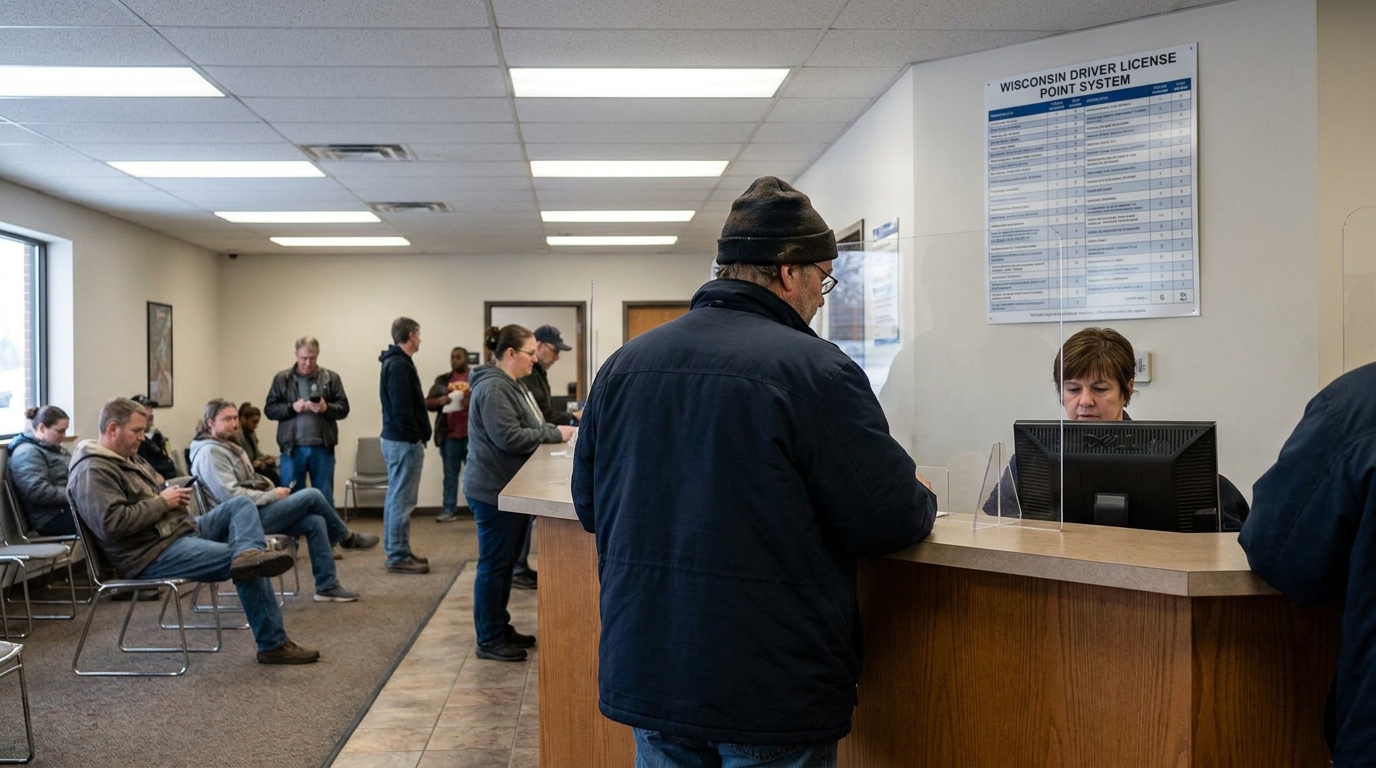
The 6 demerit points Wisconsin assigns for failure to stop sit near the top of the state’s point scale. Wisconsin’s demerit system runs from 2 points for minor infractions up to 6 points for the most serious moving violations, signaling that hit-and-run conduct is viewed as genuinely dangerous. Accumulating points can trigger license suspension, higher insurance costs, and added DOT scrutiny.
For an injured victim, these auto accident points Wisconsin tracks can be more than administrative trivia. A driver’s point history and citation may support your account, especially when liability is contested. Insurers frequently push back on fault, and a documented traffic violation points WI record can counter that resistance.
Here is a simplified view of how the point exposure typically compares:
| Conduct | Typical Demerit Points |
|---|---|
| Failure to stop after a crash | 6 points |
| Reckless driving | 6 points |
| Speeding 20+ mph over limit | 6 points |
| Failure to yield right-of-way | 4 points |
| Minor equipment violation | 0 points |
Point totals are not the same as a civil injury claim, the two processes run separately. The demerit point system is administrative and governs licensing, while your right to recover medical bills and lost wages flows from civil negligence law. Hit and run points Madison WI consequences do not, by themselves, determine your injury case value.
How Long Do Points Stay on Your License in Wisconsin
Demerit points are counted toward a possible suspension for 12 months from the violation date. The Wisconsin DOT counts points toward suspension during that rolling 12-month window, though the points and underlying conviction remain part of your broader driving record for several years. A single serious citation can affect a driver well beyond one year.
The practical effect depends on what else is on the record. A driver who accumulates 12 or more points within a 12-month period generally faces suspension, so a 6-point hit-and-run violation puts a motorist halfway there from a single incident. Repeat violations within that window escalate consequences quickly.
💡 Pro Tip: The answer to how long points count toward suspension differs from how long a conviction appears on a driving abstract. The point-counting clock and record-retention clock are not identical.
When Administrative Penalties and Criminal Charges Overlap
Demerit points are only one layer of consequence for Madison car crash penalties involving a fleeing driver. The same conduct can simultaneously trigger licensing points and criminal prosecution, and these tracks proceed independently. A driver may resolve a citation while still facing a separate felony case.
Criminal Penalties That Stack on Top of the Points
Criminal exposure for a fleeing driver can be severe and increases sharply with the harm involved. Under § 346.74(5)(a), failure to stop where the accident did not involve death or injury carries a fine of $300 to $1,000, imprisonment up to 6 months, or both. Penalties climb based on injury severity.
- Injury without great bodily harm: Under § 346.74(5)(b), fines up to $10,000, imprisonment up to 9 months, or both.
- Great bodily harm or death: Under § 346.74(5)(c)-(d), the offense becomes a Class E felony for great bodily harm and a Class D felony if death results.
Wisconsin courts have long treated these violations as felony conduct when death or injury occurs. Under § 346.74(5)(e), any hit-and-run involving death or injury is a felony, reinforced by case law in State ex rel. McDonald v. Circuit Court, 100 Wis. 2d 569, 302 N.W.2d 462 (1981). Review the graduated penalty structure in the Wisconsin crash penalty statute for context.
Liability for a hit-and-run is not always limited to the driver. Under § 346.675(1), the owner of a vehicle operated in commission of a § 346.67(1) violation may be held liable. This matters when the person behind the wheel is not the registered owner, sometimes opening additional avenues for an injured victim.
Protecting Your Rights After a Hit-and-Run Near Madison
If you were hurt by a driver who fled, prompt documentation generally makes the strongest difference. Medical records, photographs, witness statements, and the official crash report all help establish negligence, causation, and damages. Because Wisconsin follows comparative negligence principles, building a clear record early can blunt insurer arguments that you share fault.
Timing around the police report deserves special attention in Dane County. Crash reports can take time to become available. Our discussion of why Madison crash report delays happen explains what to expect while waiting for the DT4000 document that often anchors an injury claim.
💡 Pro Tip: Request your own copy of the crash report rather than relying on the insurer’s version. Having the document lets you verify accuracy before any recorded statement.
Working with a knowledgeable advocate helps you focus on recovery while your claim is built correctly. A seasoned auto accident lawyer Madison residents trust can coordinate evidence, communicate with adjusters, and prepare your case for negotiation or trial. Outcomes always depend on specific facts.
Frequently Asked Questions
1. Does a hit-and-run automatically add 6 points to a license?
In most cases, a conviction for failure to stop results in 6 demerit points, though the exact outcome can depend on the citation and driver’s record. Points and criminal charges are handled separately.
2. How long do points stay on your license in Wisconsin after a single violation?
Demerit points are counted toward suspension for 12 months from the violation date, while points and the underlying conviction may remain on your driving record far longer. The two timelines are distinct.
3. Can the vehicle owner be liable if someone else was driving?
Under § 346.675(1), the owner of a vehicle used in a § 346.67(1) violation may be held liable. This can create additional options for an injured party.
4. Do prosecutors have to prove the driver knew they hit someone?
No. Under § 346.67(3), prosecutors need not prove the operator knew he or she collided with a person or attended vehicle. This is a significant feature of Wisconsin crash reporting law.
5. Are the demerit points the same as my injury compensation?
No. Demerit points address licensing, while your civil claim addresses medical bills, lost wages, and other damages through negligence law. The point total does not set your injury case value.
Putting the Pieces Together After a Crash
Failure to stop after a crash in Wisconsin generally brings 6 demerit points, escalating criminal penalties, and potential owner liability, all of which can shape an injured victim’s path to recovery. Knowing how the point system works, including how long points count toward suspension, helps you understand the consequences the at-fault driver faces while you focus on healing and documenting your losses. Each situation turns on its own facts, so careful, timely action matters.
If a fleeing driver injured you or someone you love near Madison, the attorneys at Kent | Pincin are ready to help you move forward with confidence. Call 608.999.4954 today or send us a message through our secure contact form to discuss how we can pursue full and fair compensation on your behalf.